



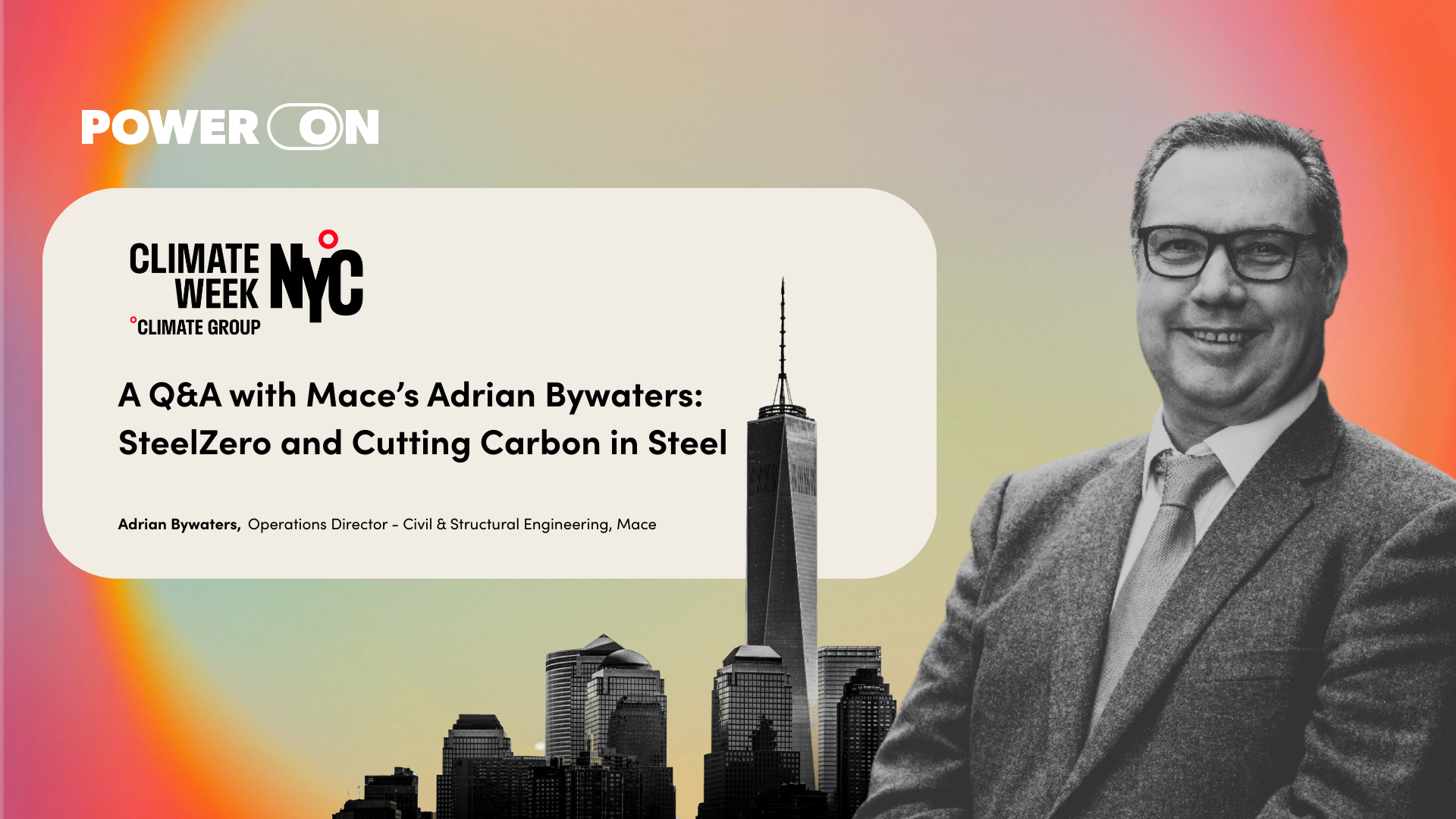
An interview with Adrian Bywaters, Operations Director, Civil & Structural Engineering at Mace, a founding member.
Steel is core to modern construction but making it low carbon is one of the sector’s biggest challenges. That’s why, at SteelZero, we work with some of the world’s largest steel-using companies on speeding up the decarbonisation of this much-used material. Adrian Bywaters from Mace, a founding SteelZero member company, spoke to us about how Mace is tackling its footprint through smarter design, early contractor involvement, and strategic procurement. Drawing on lessons from live projects, Adrian shared why timing matters, how client ambition drives innovation, and how collective action through SteelZero can help shift the market.
Q1. Could you share a recent Mace project where you have actively reduced the carbon footprint of steel, and how that reflects your SteelZero commitment?
Adrian: Our most publicised project is our 30 Duke Street office development, where we used around 750 tonnes of reused steel, making up 78% of the steel frame and saving approximately 750 tonnes of embodied carbon. This was possible because the client had an existing building on site, and we were able to reuse its steel in the new structure instead of sourcing new steel.
While this approach significantly reduced the embodied carbon, we recognise it doesn’t decarbonise new steel production – which remains central to our SteelZero commitment. This project has strengthened our expertise in steel reuse while we continue working with suppliers to increase access to near zero emission steel for future projects.
Q2. What specific design choices make the biggest difference, and why does early involvement matter?
Adrian: There’s a well-established principle in construction: your ability to influence a project starts high and drops off rapidly. We’ve used this model to explain how early involvement affects programme and cost, and carbon follows the same trajectory.
If brought in late in the process, at a completed stage 4 design, one is limited to changing construction methodologies. At stage 3, there’s scope to effect material choices. But at stages 1 and 2, one can fundamentally shape the structural layout and grid to achieve greater structural efficiency. That’s where the biggest savings are possible. The mathematics is simple: earlier involvement equals exponentially greater impact. It's a principle the industry knows well, but worth underlining – when it comes to carbon reduction, timing is everything.
Q3. How do Mace’s wider carbon commitments connect with SteelZero’s goals?
Adrian: At Mace, we’ve always talked about our carbon handprint rather than just our footprint. We first set a target to reduce one million tonnes of client carbon by 2026, which we hit within a year. That target has now grown to ten million tonnes. Most of that reduction comes through our Consult business – as client advisors and project managers, our colleagues influence design decisions and encourage early contractor engagement. But SteelZero gives us something equally important: a clear commitment to drive change from the delivery side.
What we hope is that the delivery side of the business, through our construction-focused side of the business (Construct) and SteelZero, shows in practice what low-carbon delivery looks like so we can practise what we preach. It's a virtuous cycle: we influence early through Consult, then develop the practical knowledge through our SteelZero commitment in Construct. Both sides of our business are working toward the same goal, just from different angles.
Q4. How are you working with your supply chain to accelerate this shift, and what role does SteelZero play?
Adrian: We constantly engage with our supply chain, particularly during tendering. Embodied carbon targets are now part of tender documentation, alongside cost and programme. For example, at Edge London Bridge, the initial embodied carbon was 908 kgCO₂/m², but the contractual target was 600 kgCO₂/m². We proposed low-carbon-steel solutions, including ArcelorMittal’s XCarb steel, and which, while coming at a cost uplift, we felt brought tangible benefits to the project. Most of our major contractors are SteelZero members, and we’ve even helped smaller ones, like B&K Hybrid Solutions, join. There’s rarely resistance since it’s about bridging the gap between aspirational industry targets and project-specific contractual requirements.
Q5. What has SteelZero brought to Mace and how are you progressing? Where do you see the biggest opportunities?
Adrian: SteelZero has given us a clear target of 50% lower emission steel by 2030 and we’re actively tracking compliance across projects. We’ve had multiple projects achieving higher than average compliance. These successes often come from projects with regular grids and standard rolled sections, which suit lower emission steel. We’re seeing strong performance not just from reuse strategies, like at 30 Duke Street, but also from virgin steel projects using cleaner sources. Next, we need consistent early involvement and to target projects sitting at five to ten per cent, because that’s where the step change will come from.
Q6. What are your closing thoughts on the future direction of lower emissions steel?
Adrian: We’ve made strong progress by tackling the easy wins like reusing steel, tracking carbon, and building consistency across projects. Now, the opportunity lies in shaping the medium-term strategy that bridges today’s practices with the long-term goal of net zero steel by 2050. We’re still working with familiar products and processes, but SteelZero is well-positioned to guide the industry through this next phase. With collective momentum and clearer direction, we can move beyond the low-hanging fruit and accelerate the shift to truly sustainable steel.
Find out more about SteelZero here and contact us to find out how to tackle your steel emissions today.