



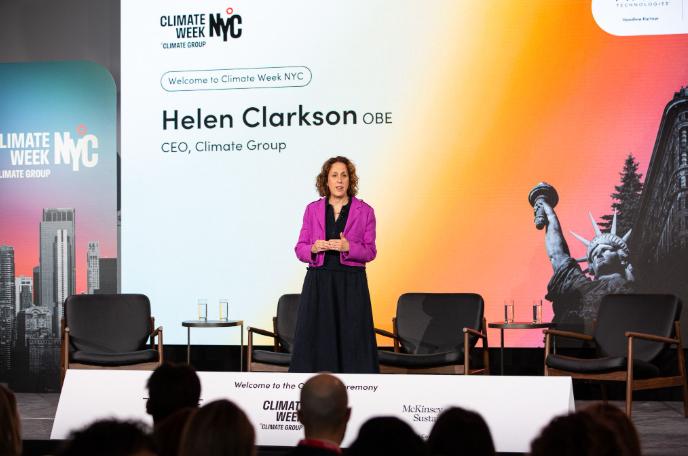
Helen Clarkson, OBE, CEO, Climate Group opened Climate Week NYC with a speech about why now is a critical time to Power On together.
Hello, and welcome to Climate Week NYC – it’s so good to see you here today in New York City. And for those of you joining online, thank you so much for tuning in. Firstly, I want to thank our partners, especially Trane Technologies, our Headline Partner and McKinsey Sustainability, our Opening Ceremony Partner, who have made this year possible.
The theme of Climate Week NYC this year is Power On. It may seem contradictory to talk about power at a time when many of us feel so powerless. So many of us start our days – as we know we probably shouldn’t – on a horrified doomscroll, bearing witness to the ways in which the world is spiralling, and feeling our lack of power or agency. We read endless opinions and polls, we can comment online, but in the end we’re just one person, with one voice, one vote. You can donate money to the causes you believe in, but then if you’re not a billionaire does it all add up?
Money talks. And at the moment it’s saying that it doesn’t want to give up on any of the riches from fossil fuels and will prioritise wealth today over a secure future tomorrow. Of course the climate is comprised of forces that are beyond our immediate control. Decades of emissions have already warmed the air and oceans with impacts felt from Los Angeles to New Delhi - flooding, landslides, wildfires.
And let’s be honest about how we talk about climate change – we tell people about the massive problems and the radical systemic changes we need. And then when people say: “but what can I do?”, we offer them reusable tote bags and infographics. We’ve been selling a feeling of powerlessness. By trying to talk about a collective action problem at an individual level, of course it doesn’t add up.
But Climate Week NYC has never been about what you can do as individuals, it’s what we can do together.
Today, we have gathered leading politicians from all levels of government. We have decision makers of some of the biggest companies in the world. We have investors, philanthropists, consultants, NGOs, activists. We know that not everyone could be here in New York due to travel restrictions. But whether you’re here in the room or online, together, we have the power to change things. And if we look at some of the incredible achievements of the past year, they all have come through flexing those collective muscles, finding collective power.
In Pakistan, solar power has become the country’s largest electricity source in just two years, up from fifth place in 2023. It wasn’t government policy that drove this – it was people. In the face of exceptionally high domestic electricity prices, they started sharing TikTok videos showing easy DIY installation of low-cost Chinese solar panels at home.
Now, the extent of the rooftop solar boom is visible on Google Earth. Even in rural villages, up to 50 percent of the roofs have solar panels. As a result, the demand for electricity on Pakistan’s National Grid is now going down, and sales of diesel dropped 35% last year. This is an incredible example of the power of collective demand.
Then, there’s the recent landmark opinion from the International Court of Justice. Starting with a group of 27 students at the University of the South Pacific in 2019, who crowdfunded just $35 for their first banner. They gained the backing of Vanuatu’s then–foreign minister Ralph Regenvanu, who we’re proud to have with us here today, and they won the support of 132 countries at the UN General Assembly. The result: the ICJ declared climate change an “existential problem of planetary proportions” and affirmed that states have binding obligations to protect the climate.
Choices made by individuals in Pakistan, or a group of students in the Pacific, shifted energy markets and profoundly changed the course of legal rulings. This happened through their collective action.
At Climate Group, we use the collective power of businesses and governments to drive change.
For example, our RE100 campaign, where businesses commit to sourcing 100% renewable electricity. In 2019, they were telling us that South Korea was one of the hardest places for companies to purchase renewables. We got to work and found a local partner to help us understand the Korean market, and six years later, Climate Group is now working with companies representing 10% of the country’s electricity use, and they want to switch that to renewables. That’s a powerful collective corporate voice, and we’re using it to drive policy change in the country.
President Lee Jae-myung highlighted RE100 in his inaugural speech a few months ago as a symbol of the country’s renewable energy strategy. He has announced a series of policy measures to speed up this transition that were partly based on our input - including RE100 industrial zones. And that’s reflective of changes across the world that are starting to hurt the fossil fuel markets.
More than 20% of new cars sold worldwide last year were electric. The global stock of electric cars displaced over 1 million barrels per day of oil consumption in 2024, according to the IEA. Wall Street’s six largest banks cut their financing of oil, gas and coal projects by 25% this year. The scales are tipping away from fossil fuels and towards clean energy.
Of course, globally there still are major barriers ahead. How do we get the renewable electricity boom onto national grids? How do we counter misinformation? How do we stay competitive in a fast-changing world, where different crises are dominating the headlines? These are the problems that we need to come together on this week.
And it’s collective power that will solve these types of problems, and that is exactly what Climate Week NYC is about – this year more than ever. Because who would have thought that together, we’d deliver the biggest Climate Week NYC yet? With more events, more sponsors and more government leaders than last year – when the world looked so different? And we didn’t even have to move it to Canada!
We’re here to Power On. In the end, either we will have a liveable planet, or we won't.
It’s an uphill struggle, but we know we don’t have a choice. It’s up to us to protect what we love.
Thank you.
Before we go to the next session, I want to thank all our sponsors again who have made this event possible: Trane Technologies, McKinsey Sustainability, and so many other valued partners.
And now, to set the tone for the conversations ahead, we’ll turn to our first speaker: the Prime Minister of Antigua and Barbuda, the His Excellency Gaston Browne, who will address the hard economics of our warming world.
Now, let’s get to it. It’s time to Power On.